
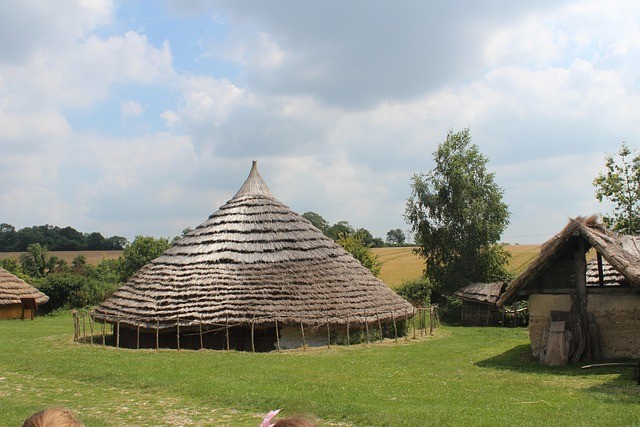
Long before modern cemeteries, crematoria and online memorials, communities in Britain were already finding meaningful ways to say goodbye to their dead. During the Iron Age (around 800 BCE to the Roman conquest in 43 CE), funeral traditions varied across regions, but they shared one common purpose: to honour the person who had died and to help the living make sense of loss.
While materials and rituals change, the human need to mark a life and express love remains constant.
Cremation and Burial: Both Were Common
In Iron Age Britain, both cremation and burial were practised. Archaeological evidence from sites such as Danebury Hillfort and Wetwang Slack shows that communities chose different approaches depending on local customs, beliefs, and perhaps social status.
Cremation involved placing the body on a funeral pyre. After the fire had cooled, the ashes and fragments of bone were carefully collected. These remains were often placed into pottery urns for burial. This careful gathering of ashes suggests deep respect and ritual significance, much as families today may treat cremated remains with tenderness and deliberation.
Why Were Some Urns Buried Upside Down?
One of the most intriguing Iron Age practices is the burial of cremation urns upside down.
Archaeologists have uncovered numerous inverted urns across Britain. At first glance, this might seem accidental. But repeated discoveries show this was deliberate. So why turn an urn upside down?
There is no written record from Iron Age Britain explaining the symbolism, but historians and archaeologists offer thoughtful interpretations:
-
Sealing the spirit: Turning the urn upside down may have symbolically “sealed” the ashes within the earth, preventing the spirit from wandering.
-
Returning to the womb of the earth: Some interpret inversion as a gesture of returning the person fully to the land, as part of the cycle of life and death.
-
Protection from disturbance: Practically, an inverted urn can sometimes offer greater stability or protection underground.
We may never know the exact meaning, but what is clear is that the position of the urn mattered. Just as families today carefully choose where ashes are scattered or interred, Iron Age communities were intentional in how they laid their loved ones to rest.
Grave Goods: What Was Buried with Them?
Many Iron Age burials included personal objects. These could range from simple items to elaborate displays, depending on the individual.
At sites like Wetwang Slack, archaeologists have found burials that included chariots, suggesting high status or importance within the community. Weapons, jewellery, tools, brooches and pottery have also been discovered.
These objects are often referred to as “grave goods.” They may have been intended for use in an afterlife, or as markers of identity: symbols of who that person was in life.
This idea resonates strongly today. Families might place letters, photographs or meaningful tokens inside a coffin. Others choose clothing, music or symbolic items that reflect personality and passions. The instinct to tell someone’s story through objects is not new; it stretches back thousands of years.
Community and Ceremony
Iron Age funerals were likely communal events. Hillfort settlements such as Danebury Hillfort show evidence of structured societies with strong social bonds. Death would not have been a private matter but something experienced collectively.
The act of building a pyre, preparing a grave, shaping pottery, or digging a burial pit required time and cooperation. These were not hurried processes. Ritual and repetition would have provided comfort and continuity.
Modern funerals continue this tradition of shared experience. Whether religious or secular, large or small, gathering together helps communities process grief. Even in its simplest form, ceremony provides structure when emotions feel overwhelming.
Regional Differences Across Britain
Iron Age Britain was not culturally uniform. In southern England, cremation was particularly common. In other areas, inhumation (burial of the body intact) was more typical. Some regions created small burial mounds; others preferred flat graves.
In East Yorkshire, the Arras Culture became known for its distinctive square barrows and chariot burials. Elsewhere, graves were simpler and less showy.
This diversity reflects something important: there has never been one single “correct” way to hold a funeral. Customs evolve according to geography, belief systems, resources and community values.
For people planning a funeral today, this can feel reassuring. There is flexibility. There is space for personal meaning.
Children and Infant Burials
Archaeologists have also discovered that infants were sometimes buried within settlement boundaries, occasionally in pots or small containers. This suggests close emotional ties and possibly different spiritual beliefs surrounding children.
Even thousands of years ago, communities adapted their funeral practices depending on age, circumstance and status, just as families do today.
What Can We Learn Today?
Iron Age funeral traditions may feel distant, but they highlight enduring truths:
-
People have always sought meaning in death.
-
Ritual matters.
-
Objects carry stories.
-
The way we position, place or prepare remains is often symbolic.
-
There is no single “right” approach.
The image of an urn buried upside down reminds us that even the smallest detail in a funeral can carry weight. It can express belief, love, protection, or hope — even if outsiders do not immediately understand it.
At The Farewell Guide, we sometimes hear from families who worry about “doing it right.” History tells us there has never been one universal template. What mattered in the Iron Age was intention. The same is true now.
Whether someone chooses burial, cremation, natural burial, scattering, or something entirely personal, the heart of the ritual is care.
Thousands of years from now, archaeologists may puzzle over our own traditions — biodegradable coffins, personalised ashes jewellery, digital memorial pages. They may not fully understand our symbolism either. But they will recognise what sits at the centre of it all: love, remembrance and the human need to mark a life.
And perhaps that is the most powerful continuity of all. If you want to make your funeral wishes know, complete and share your funeral plan with your loved ones at www.thefarewellguide.co.uk today.