
Losing someone you love is hard enough without the added complexity of not knowing what happens to what they left behind. Yet this is the reality for a considerable number of families in the UK every year. Research suggests that more than half of adults in the UK do not have a valid will, which means that when they die, the law rather than their own wishes determines who receives their estate.
If you are dealing with the loss of someone who died without a will, or if you are thinking about what might happen to your own estate if you were to die without one, this guide explains the intestacy rules clearly, who is entitled to inherit under them, and what practical steps families need to take during what is already an incredibly difficult time.
When someone dies without a valid will in England and Wales, they are said to have died intestate. Their estate is then distributed according to the Rules of Intestacy, a fixed legal framework that makes no allowance for personal wishes, relationships outside of marriage, or the specific circumstances of the family left behind.
What Are the Rules of Intestacy?
The Rules of Intestacy are a set of legal provisions that determine how a person's estate is divided when they die without a valid will. They apply in England and Wales. Scotland and Northern Ireland have their own separate intestacy rules, which differ in some important respects.
The rules follow a strict order of priority based on family relationships. They do not consider the length or closeness of a relationship, the wishes the deceased may have expressed verbally, or the financial needs of the people left behind. They simply apply the hierarchy as written, regardless of whether the outcome reflects what the person would have wanted.
Who Inherits Under the Intestacy Rules?
The order of priority under the intestacy rules in England and Wales is as follows:
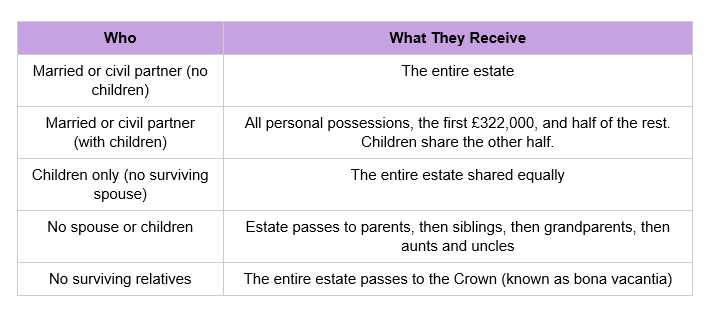
It is important to note that children inherit equally under the intestacy rules, including children from earlier relationships. Stepchildren, however, have no automatic right to inherit unless they were legally adopted. Grandchildren may inherit if their parent (the deceased's child) has already died.
What About Unmarried Partners?
This is one of the most significant and often most painful aspects of the intestacy rules. An unmarried partner, however long the relationship, however deeply committed, and however intertwined their lives, has no automatic right to inherit anything under the intestacy rules in England and Wales.
This could leave a surviving partner in an extremely vulnerable position, particularly if they shared a home, had children together, or were financially dependent on the person who has died. In some cases, the surviving partner may face losing the family home because it passes to the deceased's children or other relatives rather than to them.
If you are in a long-term relationship and are not married or in a civil partnership, writing a will is not just advisable, it is the only legal mechanism that ensures your partner is protected. Without one, the law offers no provision for them at all.
What Is the Process When Someone Dies Intestate?
When someone dies without a will, a family member or other eligible person must apply to the Probate Registry for a document called Letters of Administration. This is the equivalent of the Grant of Probate that an executor named in a will would obtain, and it gives the administrator legal authority to deal with the deceased's estate.
The person entitled to apply for Letters of Administration follows the same order of priority as the intestacy rules themselves. So, a surviving spouse or civil partner would be the first to apply, followed by children, and then other relatives in order.
Once Letters of Administration have been obtained, the administrator must gather all the assets of the estate, pay any debts and liabilities including any inheritance tax due, and then distribute what remains in accordance with the intestacy rules. This process can take many months, and in complex estates or where there are disputes among family members, longer.
Dealing with an intestate estate is always more time consuming, more expensive, and more stressful than administering an estate where a clear, valid will exists. A solicitor experienced in probate and estate administration can provide invaluable support during this process.
Can the Intestacy Rules Be Overridden?
In some circumstances, it is possible to vary the way an intestate estate is distributed after the person has died. A Deed of Variation allows the beneficiaries of an estate to agree to redistribute assets differently from how the intestacy rules would provide, provided all affected parties' consent. This can be useful where, for example, the beneficiaries under the intestacy rules wish to make provision for someone who would not otherwise receive anything, such as an unmarried partner or a stepchild.
A Deed of Variation must be completed within two years of the date of death and must be drawn up carefully with legal advice to ensure it is valid and does not create unintended tax consequences.
It is also possible for someone who has been financially dependent on the deceased but is not entitled to inherit under the intestacy rules to make a claim against the estate under the Inheritance (Provision for Family and Dependants) Act 1975. This includes unmarried partners, stepchildren, and others who can demonstrate that they were being maintained by the deceased at once before their death. Such claims are assessed by the court, can be complex, and costly, which is why prevention through a properly drafted will is always the better approach.
What Can Families Do Right Now?
If you are currently dealing with the loss of someone who died without a will, the most important first step is to seek legal advice from a solicitor who specializes in probate and estate administration. They can guide you through the process of applying for Letters of Administration, advise on your rights and entitlements under the intestacy rules, and help you understand whether a Deed of Variation might be appropriate in your circumstances.
It is also worth taking this moment, however difficult, to reflect on your own situation. If you do not currently have a valid will, the experience of navigating an intestate estate is a powerful reminder of why it matters. Writing a will is not a morbid act. It is one of the most considerate and practical things you can do for the people you love.
At The Farewell Guide, we are here to support families through every aspect of end-of-life planning and bereavement. Our free funeral planning tool allows you to record your funeral wishes and store important documents so that your loved ones have clear guidance when the time comes. Our support centre provides free resources on every aspect of loss, from arranging a funeral and understanding the legal process to supporting children through grief and looking after your own wellbeing during bereavement. Visit www.thefarewellguide.co.uk to access our full range of free tools and guidance, and to find trusted funeral directors near you.