

A Lasting Power of Attorney is one of the most important legal documents you can put in place during your lifetime, yet it is one that most adults in the UK have not arranged. Many people associate it with old age or serious illness, but the reality is that no one knows when they might lose the mental capacity to make decisions for themselves. An accident, a sudden illness, or the onset of a condition such as dementia can happen at any age and at any time.
This guide explains what a Lasting Power of Attorney is, the two types available in England and Wales, why setting one up matters, what happens if you do not have one, and the steps involved in putting one in place.
A Lasting Power of Attorney must be set up while you still have mental capacity. Once capacity is lost, it is too late to create one. This is one of the most important reasons to act sooner rather than later.
What Is a Lasting Power of Attorney?
A Lasting Power of Attorney, commonly referred to as an LPA, is a legal document that allows you to appoint one or more people, known as attorneys, to make decisions on your behalf if you are no longer able to do so yourself. The person creating the LPA is called the donor. The attorneys you appoint can be family members, close friends, or professionals such as solicitors.
The key word in the name is lasting. Unlike an ordinary power of attorney, which ceases to be valid if the donor loses mental capacity, a Lasting Power of Attorney is specifically designed to remain in effect even when capacity is lost. This is precisely what makes it so valuable as a planning tool.
In England and Wales, LPAs are governed by the Mental Capacity Act 2005 and must be registered with the Office of the Public Guardian before they can be used. There are two distinct types of LPA, and they cover entirely different areas of your life.
The Two Types of Lasting Power of Attorney
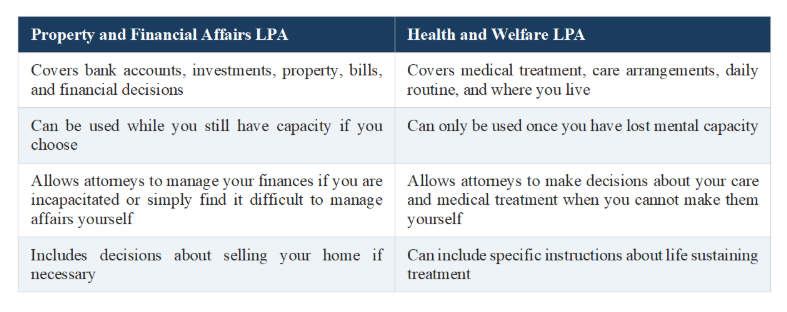
Most people who set up an LPA choose to create both types. They serve different purposes and the absence of either one can leave significant gaps in the protection available to you and your family.
Why Does a Lasting Power of Attorney Matter?
The most straightforward answer is that without an LPA, the people who love you may have no legal authority to help you when you need it most. If you lose mental capacity and have not set up an LPA, your family cannot simply step in and manage your finances or make decisions about your care. The law does not automatically grant these powers to a spouse, a partner, or an adult child.
Instead, anyone who wishes to manage your affairs on your behalf would need to apply to the Court of Protection for a deputyship order. This process is significantly more complex, more time consuming, and more expensive than setting up an LPA in advance. It can take many months to resolve, during which time your finances may be inaccessible and important decisions about your care may be delayed.
An LPA removes this uncertainty. It ensures that the person or people you trust are able to act on your behalf at once when needed, without having to navigate a lengthy legal process at an already difficult time.
Who Should Have a Lasting Power of Attorney?
The short answer is every adult. LPAs are not only for the elderly or those with a diagnosed condition. Consider the following scenarios:
• A young adult who is involved in a serious accident and requires intensive care. Without an LPA, even their parents may have no legal authority to access their bank account or make decisions about their medical treatment.
• A person in their forties who is diagnosed with early onset dementia. With an LPA already in place, their chosen attorneys can begin supporting them immediately and take over fully when capacity is lost.
• A business owner who travels frequently or works in a high-risk environment. An LPA for property and financial affairs ensures their affairs can be managed in their absence or in an emergency.
• A person going into hospital for a serious operation. An LPA provides reassurance that decisions can be made if the operation does not go as planned.
The common thread in all of these scenarios is that the need for an LPA arises suddenly and without warning. Setting one up in advance costs relatively little and provides significant protection.
How to Set Up a Lasting Power of Attorney
Setting up an LPA in England and Wales involves several steps. The process can be completed independently using the forms available from the Office of the Public Guardian, or with the assistance of a solicitor who specializes in private client or elder law matters.
The steps involved are as follows. First, you choose your attorneys. You should select people you trust absolutely, as they will have significant powers over your affairs. You may appoint more than one attorney and specify whether they must act jointly, meaning together on every decision, or jointly and severally, meaning either one can act independently.
Second, you complete the LPA forms. There is a separate form for each type of LPA. The forms require you to specify your attorneys, set out any instructions or preferences you wish your attorneys to follow, and identify a certificate provider, who is an independent person who confirms that you understand the document and are not being pressured into signing it.
Third, the LPA must be signed by you, your certificate provider, and your attorneys in the correct order as specified in the form. Fourth, the completed and signed forms are given to the Office of the Public Guardian for registration, along with the registration fee. As of 2026 the registration fee is £82 per LPA, meaning £164 for both types. Fee remission is available for those on low incomes.
The registration process currently takes several weeks. The LPA cannot be used until it has been registered, which is a further reason to set it up well in advance of any predicted need.
Is a Lasting Power of Attorney the Same as a Will?
No. A will and a Lasting Power of Attorney serve entirely different purposes, and one does not substitute for the other. A will sets out what should happen to your estate after your death. An LPA sets out who should make decisions on your behalf during your lifetime if you lose capacity. Both documents are important components of a comprehensive end of life plan, and ideally both should be in place.
It is also worth noting that a will only takes effect after death. An LPA only works during your lifetime. The moment of death ends the authority of any attorneys appointed under an LPA, and the administration of the estate then passes to the executors named in the will.
How The Farewell Guide Can Help
At The Farewell Guide, we are committed to helping individuals and families plan ahead with clarity and confidence. Our free funeral planning tool allows you to record your end of life wishes, including your preferences for care and your funeral arrangements, so that the people you trust have clear guidance when they need it most. Our support centre provides free resources on every aspect of end-of-life planning, from writing a will and setting up an LPA to arranging a funeral and supporting a bereaved family. Visit www.thefarewellguide.co.uk to access our full range of free tools and guidance.